
Quick answer: You do not have to buy an expensive insert, specialty shoe, roller, brace, or night splint before you can start helping a painful foot. Gentle stretching, reducing the activities that clearly aggravate the pain, cold therapy, simple strengthening, and using the most supportive shoes you already own may all help. None of these steps can diagnose your pain or guarantee recovery, but they can give you a sensible place to start without spending money.
When your heel hurts, the internet can make it sound as though recovery begins with a shopping cart.
A new pair of shoes. A premium insert. A massage tool. A night splint. A special sock. A brace. Before long, the “simple” solution costs more than the weekly grocery bill.
That is not how we want PlantarFasciitisInserts.com to treat people.
Products can be useful. Bob and Lisa have both benefited from supportive footwear, inserts, stretching, and other tools. But buying something is not always the first step, and it should never be presented as the price of admission for getting useful help.
Lisa remembers using frozen water bottles, bags of frozen peas, tennis balls, and whatever else was already in the house when walking across the room had become miserable. Some things helped more than others, and none was magic. The important lesson was that useful first steps did not all come from a store.
This article gives you a practical zero-dollar starting plan using ordinary things you may already have.
Free does not mean useless. And expensive does not automatically mean effective.
First, Make Sure This Is the Kind of Pain You Should Manage at Home
Pain around the heel or arch—especially pain that is worse with the first steps after sleep or rest—is commonly associated with plantar fasciitis. But several other problems can cause pain in the same general area.
This article cannot tell you what is causing your pain.
Seek medical advice sooner rather than continuing to experiment on your own if:
- The pain is severe or stops you from doing normal activities.
- The pain is getting worse rather than gradually settling.
- The pain keeps returning.
- You have tingling, burning, numbness, or loss of feeling.
- The pain began after a fall, impact, or other injury.
- You have marked swelling, redness, warmth, fever, or an open wound.
- You have diabetes and new foot pain.
- You have tried reasonable self-care for about two weeks without improvement.
Those are not signs that you failed. They are signs that it is time to stop guessing.
The Zero-Dollar Starter Plan
You do not need to do everything at once. Start with the following five actions.
1. Reduce what is clearly aggravating the pain
“Rest” does not have to mean lying down all day. It means reducing or temporarily changing the activity that is repeatedly making the pain worse.
For example:
- Shorten a long walk rather than forcing yourself through it.
- Break one long standing task into several shorter sessions.
- Switch temporarily from high-impact exercise to something lower impact that does not aggravate the foot.
- Sit for jobs that do not truly require standing.
- Use a stool or chair while cooking, folding clothes, gardening at a table, or doing other household tasks.
- Ask for short sitting breaks at work when that is possible.
Pain is not a character test. Pushing through worsening heel pain does not prove determination.
At the same time, complete inactivity is not automatically the answer. Gentle movement that does not increase symptoms may be more practical than either extreme.
A simple rule
During an activity, ask:
“Is this staying tolerable, or is it steadily making the pain worse?”
If the pain is climbing, change the activity, shorten it, or stop and try again later.
2. Use cold with something already in your freezer
Cold may help calm pain after standing, walking, or activity.
You have two simple options.
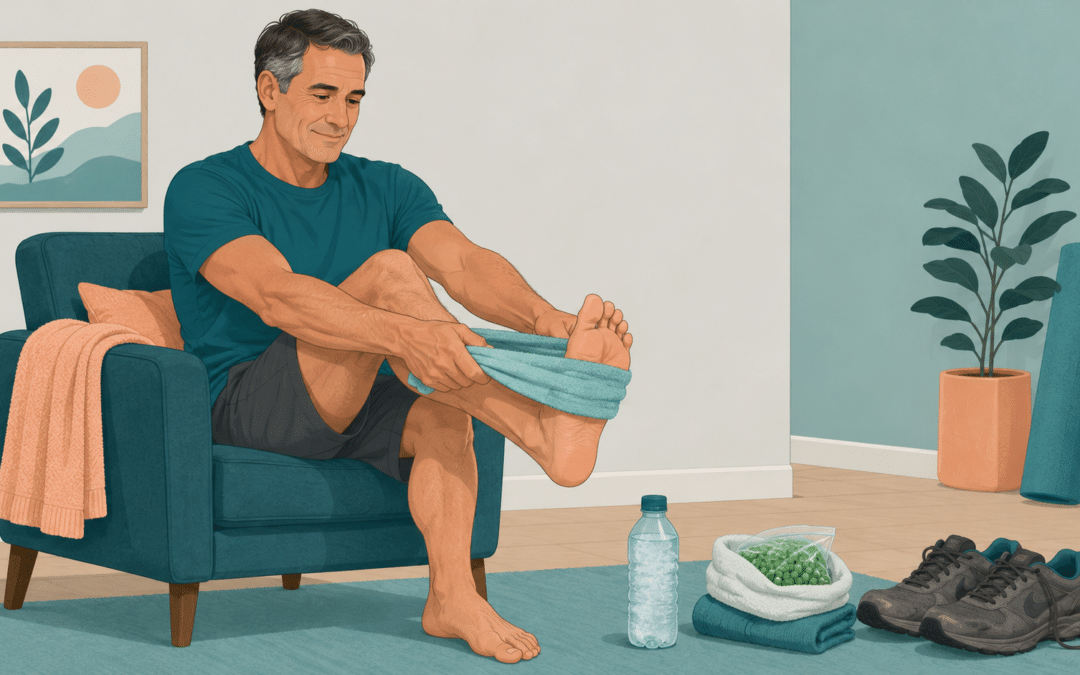
Option A: Frozen-water-bottle roll
- Fill a plastic water bottle partway, leaving room for the water to expand.
- Freeze it.
- Sit in a stable chair.
- Place the bottle under the foot.
- Roll the foot gently from the heel toward the ball of the foot.
- Keep the pressure comfortable. More pressure is not automatically better.
- Stop if the rolling causes sharp pain, numbness, or worsening symptoms.
The American Academy of Orthopaedic Surgeons describes rolling the foot over a cold water bottle or ice for about 20 minutes.
Option B: Ice pack or frozen vegetables
- Wrap the ice pack or bag of frozen peas in a thin towel.
- Place it under or against the painful area.
- Use it for up to about 20 minutes.
- Never put ice directly against bare skin.
- Check the skin regularly and stop if it becomes painfully cold, very pale, or numb.
Lisa used frozen peas because they were already available and molded around the foot. The peas were not a cure. They were simply an inexpensive way to make a bad moment more manageable.
Use extra caution with cold if you have reduced sensation, diabetes, or circulation problems. Ask a clinician or pharmacist what is appropriate for you.
3. Stretch before the first painful steps
Many people describe the first steps after sleep or sitting as the worst part of the day. A gentle stretch before putting full weight on the foot may make those first steps easier.
For a fuller stretching routine, see Effective Stretches for Heel Pain Relief.
Seated plantar-fascia stretch
- Sit on the edge of the bed or in a chair.
- Cross the painful foot over the opposite knee.
- Hold the toes and gently pull them back toward the shin.
- You may feel a stretch along the arch and bottom of the foot.
- Hold for about 10 seconds.
- Relax and repeat gently several times.
Do not yank the toes backward. This should feel like a controlled stretch, not a test of how much pain you can tolerate.
If reaching the toes is difficult, loop a towel around the front of the foot and pull gently.
Towel stretch before getting out of bed
- Sit with the leg straight or slightly bent.
- Loop a towel around the ball of the foot.
- Hold one end of the towel in each hand.
- Gently pull the foot toward you while keeping the knee comfortable.
- Hold briefly, release, and repeat.
This uses an ordinary bath towel instead of a stretching strap.
4. Stretch the calf as well as the foot
Tight calf muscles can limit ankle movement and increase strain through the foot. Bob and Lisa both found wall stretches useful enough to keep doing after their worst pain had settled.
Straight-knee wall calf stretch
- Face a wall and place both hands on it.
- Step the painful side behind you.
- Keep the back knee straight.
- Keep the back heel on the floor.
- Bend the front knee and move the hips gently toward the wall.
- Stop when you feel a controlled stretch in the back calf.
- Hold for about 10 to 30 seconds.
- Relax and repeat.
Keep both feet pointing mostly forward. Do not bounce.
Bent-knee calf stretch
Use the same position, but bend the back knee slightly while keeping the heel down. This shifts the stretch lower in the calf.
The goal is not to force range of motion. The goal is to create a tolerable stretch that you can repeat consistently.
Consistency beats brutality. A stretch you can do regularly is more useful than one you avoid because it hurts.
5. Begin gentle strengthening only when it is tolerable
Stretching may help with mobility and short-term comfort. Strengthening may help your foot and lower leg handle everyday load more effectively over time.
For more options, see Top 5 Strengthening Exercises for Plantar Fasciitis.
Do not turn this into a hard workout on day one.
Supported heel raises
- Stand near a counter, heavy chair, or wall.
- Hold it lightly for balance.
- Rise slowly onto the balls of both feet.
- Pause briefly.
- Lower slowly.
- Begin with a small number of comfortable repetitions.
Stop if the exercise causes sharp pain, a sudden increase in heel pain, or symptoms that remain significantly worse afterward.
Towel scrunches
- Sit in a chair.
- Place a small towel flat on the floor.
- Keep the heel down.
- Use the toes to pull the towel toward you.
- Relax the foot between repetitions.
This costs nothing, but it is not mandatory. Some people find toe exercises irritating. Skip it if it clearly worsens your symptoms.
The “next morning” check
An exercise may feel acceptable while you are doing it and still be too much.
The next morning, ask:
- Are my first steps about the same?
- Are they a little easier?
- Or are they noticeably worse?
If symptoms are clearly worse, reduce the repetitions, reduce the range, or pause that exercise.
Use the Best Shoes You Already Own
The phrase “supportive footwear” can sound like a demand to buy something.
Start by inspecting what is already in your closet.
Choose the pair that:
- Feels most stable under the heel.
- Has enough room for the toes.
- Does not force the foot into a painful position.
- Is not worn completely flat or tilted to one side.
- Stays securely on the foot.
- Makes walking feel more tolerable than your other choices.
The best temporary choice may be an athletic shoe, walking shoe, work shoe, or other closed shoe you already own. Brand name does not matter for this step.
For more help evaluating footwear, see Best Footwear for Plantar Fasciitis.
If your most supportive pair is badly worn, see When to Replace Plantar Fasciitis Shoes.
Around the house
The NHS advises trying not to walk barefoot on hard surfaces. Bob and Lisa also found that reducing barefoot time—especially on hard floors—became an important long-term habit.
That does not mean everyone must wear shoes every waking minute. It means paying attention to whether barefoot walking on tile, concrete, or hardwood predictably makes your pain worse.
Use the most comfortable, stable indoor footwear you already own.
What not to improvise inside a shoe
Do not stuff folded cardboard, towels, sponges, loose foam, or other household material into the shoe as a homemade insert. It can bunch, slide, change the fit, and create new pressure points.
If you already own an insert that fits safely and feels better, use it. But this article is about what you can do even when you do not.
A Simple Daily Routine That Costs Nothing
Here is a manageable routine using only a wall, chair, towel, and freezer.
Before getting out of bed
- Seated plantar-fascia stretch
- Gentle towel stretch
- A few ankle circles if comfortable
During the day
- Wear the most supportive shoes already available.
- Avoid long barefoot periods on hard floors if they aggravate the pain.
- Break up long standing or walking periods where possible.
- Do one or two gentle calf-stretch sessions.
- Sit for tasks that do not require standing.
After a demanding period on your feet
- Use a wrapped ice pack, frozen peas, or a frozen-water-bottle roll for up to about 20 minutes.
- Elevate the foot while sitting if that feels helpful.
- Note which activity triggered the flare.
When symptoms are tolerable
- Add a small number of supported heel raises.
- Increase gradually rather than adding many repetitions at once.
You do not need a color-coded tracker. A scrap of paper is enough.
Write down:
- Morning pain: better, same, or worse
- Longest standing or walking period
- What seemed to aggravate it
- What seemed to help
Patterns are more useful than perfect records.
What About Pain Medicine?
Pain medicine is not free for everyone, and it is not safe for everyone.
The NHS lists options such as paracetamol, ibuprofen gel, or ibuprofen tablets, but medications can interact with health conditions and other medicines. A pharmacist can help you determine what may be appropriate.
Do not assume that an over-the-counter medicine is automatically safe because it is sold without a prescription.
This article is not the place for us to tell you which medicine to take or how much to use.
What Not to Spend Money On Yet
When money is tight, protect it.
Before buying anything, avoid:
- A large “treatment kit” containing several products you have never tried.
- An expensive insert based only on star ratings.
- A product that cannot fit the shoes you actually wear.
- A device advertised as a cure.
- A painful roller you believe you must endure to “break up” the problem.
- Multiple products started on the same day, making it impossible to know what helped.
- Replacing every shoe before you know which feature actually matters.
When you eventually have money available, the first purchase should solve a clearly identified problem—not simply be the most heavily advertised item.
For one person, that may eventually be replacing a dangerously worn work shoe. For another, it may be a modest insert that fits an otherwise good shoe. For someone else, the smartest use of limited money may be a professional evaluation because the symptoms do not fit the usual pattern.
Before spending money on an insert, read How to Choose Plantar Fasciitis Inserts.
When Free Self-Care Is Not Enough
A zero-dollar plan is a starting point, not a promise.
Get professional help when:
- Pain is severe or disabling.
- Pain is worsening.
- Pain repeatedly returns.
- There is numbness, tingling, burning, weakness, or loss of feeling.
- You cannot bear weight normally.
- There was an injury.
- You have diabetes and foot pain.
- Two weeks of reasonable self-care has not produced improvement.
- You are unsure whether the pain is actually plantar fasciitis.
Possible lower-cost sources of help may include:
- A primary-care clinic
- A community health center
- A physical-therapy or podiatry clinic with sliding-scale options
- A pharmacist for medication questions
- A health-insurance nurse line
- A local teaching clinic
- A workplace health program
- A county or nonprofit clinic
Availability varies, but asking about reduced fees or payment plans costs nothing.
The Honest Bottom Line
You may eventually benefit from better shoes, an insert, a night splint, physical therapy, or another form of care.
But you do not have to buy your way into taking the first sensible steps.
Start with:
- Reducing the activity that is clearly making the pain worse.
- Using cold safely.
- Stretching the plantar fascia before the first steps.
- Stretching the calf gently.
- Adding light strengthening when tolerable.
- Wearing the most supportive shoes you already own.
- Getting help when the symptoms are severe, unusual, worsening, or persistent.
Bob and Lisa both learned that recovery was not one magic product. It was a collection of habits used consistently. They also learned that feeling better did not mean foot care no longer mattered.
Relief is Phase One. Maintenance is Phase Two.
You should not have to spend money you do not have just to receive an honest place to begin.
Keep reading
- Start here: Natural Plantar Fasciitis Relief: 5 Home Remedies
- Best Way to Relieve Plantar Fasciitis Pain
- Best Home Remedies for Plantar Fasciitis: Quick Relief
- Walking with Plantar Fasciitis: Stay Active and Pain Free
Sources
- American Academy of Orthopaedic Surgeons: Plantar Fasciitis and Bone Spurs
- NHS: Plantar Fasciitis
- American Academy of Orthopaedic Surgeons: Foot and Ankle Conditioning Program
Medical-Information Disclaimer
We are not medical professionals. This article shares general educational information and personal experience. It cannot diagnose the cause of foot pain, replace an examination, or determine which exercises are safe for a particular person. Stop any activity that causes sharp pain or a marked worsening of symptoms. Persistent, severe, unusual, or worsening foot pain deserves evaluation by a qualified healthcare professional.