Disclosure: This post may contain affiliate links. If you buy through them, we may earn a small commission at no extra cost to you.
The Bottom Line: Custom Orthotics Can Help — But They Are Not Step One for Everybody
Custom orthotics for plantar fasciitis may be worth it when heel pain is stubborn, recurring, or tied to unusual foot mechanics. But if your plantar fasciitis is mild or fairly new, a good over-the-counter insole, supportive shoes, stretching, and smarter daily habits are usually the first moves before you launch the budget torpedoes.
Quick Answer: Are Custom Orthotics Worth It for Plantar Fasciitis?
Custom orthotics may be worth it if you have severe or persistent plantar fasciitis, unusual foot shape, high arches, flat feet, recurring flare-ups, or pain that has not improved with good shoes and quality over-the-counter insoles. For many people, though, custom orthotics are a second-line upgrade, not the first thing to buy.
Custom orthotics sound fancy. Maybe too fancy. They have that “someone in a white coat measured your foot with instruments” energy, which can make them feel like the obvious next step when your heel is still barking at sunrise.
But here is the honest Bob-and-Lisa version: custom orthotics can be excellent for the right person. They can also be expensive overkill if your feet would have been perfectly happy with a good structured insole and a shoe that does not behave like a wet tortilla.
If you are still sorting out the broader insole landscape, start with our hub guide:
Best Insoles for Every Budget and Lifestyle.
For the beginner version, see
Insoles Basics for Plantar Fasciitis.
And if you want the “why this stuff matters” explanation, read
Why Insoles Matter for Plantar Fasciitis.
This Guide Is for You If…
- You have tried budget or premium insoles and your heel is still staging a tiny foot rebellion.
- You are wondering whether custom orthotics are worth the bigger price tag.
- Your podiatrist, physical therapist, or healthcare provider mentioned orthotics and you want plain-English context.
- You have high arches, flat feet, recurring plantar fasciitis, or unusual shoe-fit problems.
- You want to avoid spending hundreds of dollars before you know whether the mission actually requires it.
Medical note: Custom orthotics are medical devices when prescribed by a qualified professional. If your heel pain is severe, persistent, worsening, or comes with numbness, swelling, diabetes concerns, or trouble walking normally, get evaluated by a healthcare professional before trying to fix it with inserts alone.
1) What Are Custom Orthotics?
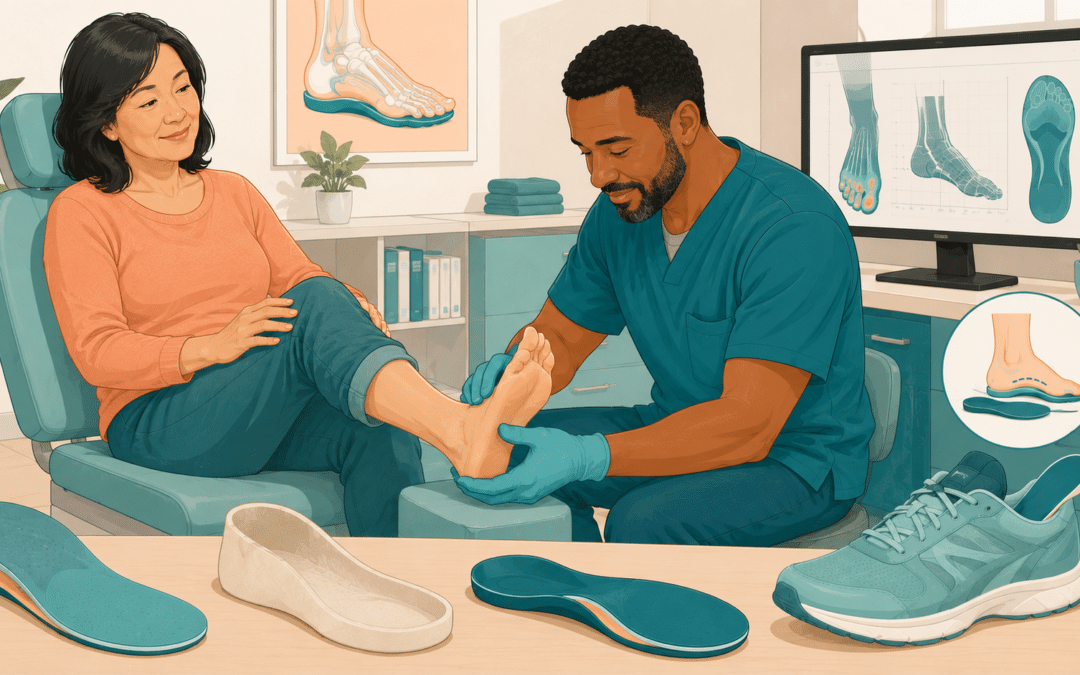
Custom orthotics are shoe inserts made specifically for your feet. They are usually prescribed after a podiatrist or other qualified provider evaluates your foot structure, walking pattern, pain history, and footwear needs.
Think of over-the-counter insoles like buying a good suit off the rack. It may fit well enough to look sharp and do the job. Custom orthotics are more like having the suit tailored. The goal is not just “soft under the heel.” The goal is support shaped around how your foot actually moves.
The American Podiatric Medical Association explains that prescription custom orthotics are made only after a podiatrist evaluates the feet, ankles, and legs, and that they are designed to match your foot contours and movement pattern. Mayo Clinic also notes that a healthcare professional may prescribe off-the-shelf or custom-fitted arch supports to help distribute pressure more evenly across the feet.
References:
APMA: prescription custom orthotics and shoe inserts,
Mayo Clinic: plantar fasciitis treatment.
Action Box: The “Do I Need Custom?” First Question
Before spending custom-orthotic money, ask yourself this:
- [ ] Have I tried supportive shoes with removable liners?
- [ ] Have I tried a structured over-the-counter insole for at least a fair break-in period?
- [ ] Have I reduced barefoot time on hard floors?
- [ ] Have I done basic calf and plantar fascia stretching consistently?
- [ ] Is the pain still persistent, recurring, or limiting normal activity?
If you answered “yes” to that last question after doing the basics, custom orthotics move higher on the list.
2) How the Custom Orthotics Process Usually Works
The exact process varies by provider, but most custom orthotic appointments follow the same general path.
| Step | What Usually Happens | Why It Matters |
|---|---|---|
| Exam | Your provider checks your pain location, foot shape, arch, gait, and history. | Heel pain is not always simple plantar fasciitis. The cause matters. |
| Cast or scan | Your feet may be molded, scanned, or measured. | The insert is shaped around your specific foot mechanics. |
| Build | The orthotics are made from materials selected for your needs. | Some orthotics control motion; others cushion and accommodate pressure. |
| Fit check | You test them in your shoes and may need small adjustments. | Even custom gear can need tuning. Your feet get a vote. |
Lisa’s note: “When I finally tried custom orthotics, the biggest difference was that they felt like they belonged to my feet. Not just feet in general. Mine.”
3) Custom Orthotics vs Over-the-Counter Insoles
Here is the part where the marketing fog rolls in. “Custom” sounds automatically better. Sometimes it is. But “better” depends on the foot, the pain pattern, the shoe, and how much correction or support you actually need.
| Option | Best For | Watch Out For |
|---|---|---|
| Budget OTC insoles | Mild heel pain, first experiments, tight budgets. | May flatten faster or offer too little arch support. |
| Premium OTC insoles | People who need firmer support, better durability, or more heel stability. | May still be wrong for unusual feet or severe recurring pain. |
| Custom orthotics | Persistent pain, unusual foot mechanics, high arches, flat feet, recurring flare-ups, or provider-recommended correction. | Higher cost, possible insurance hassle, break-in period, and sometimes follow-up adjustments. |
If you are deciding between budget options, see
Budget Showdown: Dr. Scholl’s vs WalkFit.
If you are comparing more serious store-bought support, see
Premium Insole Face-Off: Superfeet vs PowerStep.
4) When Custom Orthotics Are More Likely to Be Worth It
Custom orthotics move from “maybe later” to “seriously consider this” when the usual fixes are not enough. That does not mean panic-buying expensive foot hardware. It means getting a professional opinion because the problem may be more specific than a generic insert can handle.
- Your pain keeps coming back: recurring plantar fasciitis may point to mechanics that need more precise support.
- You have unusual arches: very high arches, very flat feet, or obvious foot asymmetry can make off-the-shelf fitting harder.
- You have multiple pain sites: heel pain plus knee, hip, ankle, or forefoot problems can mean the whole chain needs attention.
- Good OTC insoles failed: if budget and premium insoles did not help after a fair test, custom may be the next logical step.
- Your provider recommends them: especially after watching how you walk and examining your foot structure.
Cleveland Clinic lists both over-the-counter and custom orthotics or arch supports among nonsurgical plantar fasciitis treatments. The key word there is “or.” Custom is one option in the toolbox, not the only tool in the shed.
Reference:
Cleveland Clinic: plantar fasciitis treatment options.
Bob’s Take: Do Not Buy a Battleship for a Canoe Problem
If your heel pain is new, mild, and mostly caused by terrible shoes, custom orthotics may be overkill. Start with better shoes, better insoles, and basic stretching. But if your plantar fasciitis keeps returning like a villain who missed the end credits, get a professional involved.
5) When Custom Orthotics May Be Overkill
Custom orthotics are not magic. They are tools. Good tools are wonderful. Wrong tools are expensive drawer decorations.
They may be overkill if:
- Your plantar fasciitis is mild and new.
- You have not tried supportive shoes yet.
- You are still walking barefoot on hard floors most of the day.
- You have not tested a structured OTC insole.
- You expect orthotics to replace stretching, activity changes, and common sense.
That last one matters. Orthotics can reduce strain, but they do not give you a license to ignore every other part of recovery. Plantar fasciitis is rarely impressed by one shiny purchase.
6) The Real Cost Question
Custom orthotics can cost a lot more than off-the-shelf insoles. Pricing varies by clinic, materials, insurance coverage, and whether follow-up adjustments are included. Instead of asking only “What do they cost?” ask a better question:
“What problem am I paying them to solve?”
If the problem is “my shoes are flimsy and I need basic arch support,” a premium OTC insole may solve it. If the problem is “my foot mechanics keep recreating the same pain pattern no matter what I try,” custom orthotics may make more sense.
| Situation | Likely First Move |
|---|---|
| New heel pain, bad shoes, low budget | Supportive shoes + budget or premium OTC insoles |
| Active lifestyle, moderate pain, needs better support | Premium OTC insoles and shoe-fit upgrades |
| Recurring pain, unusual arches, failed OTC attempts | Professional evaluation and possible custom orthotics |
| Severe pain, limping, numbness, swelling, or diabetes concerns | Healthcare evaluation first |
7) Questions to Ask Before Buying Custom Orthotics
If you do meet with a podiatrist, orthotist, or other provider, bring questions. Do not just nod politely while your wallet crawls under the chair.
Appointment Checklist: Ask These Before Saying Yes
- What specific foot mechanics are we trying to correct or support?
- Would a premium OTC insole be a reasonable first test?
- What type of orthotic are you recommending: functional, accommodative, or something else?
- How long should I break them in?
- What adjustments are included if they create pressure points?
- Will they fit my actual shoes, or do I need different shoes?
- How long should they last?
- Will insurance cover any part of the cost?
8) Break-In: Even Custom Orthotics Need a Trial Period
Custom does not always mean instantly comfortable. If your feet have been collapsing into soft, flat, tired shoe liners for years, stronger support can feel strange at first.
- Start slow: wear them for a short period the first day.
- Increase gradually: build up wear time as your feet adapt.
- Watch for red flags: sharp pain, numbness, tingling, blisters, or limping are not “just breaking in.”
- Use the right shoes: a custom orthotic still needs enough room and a stable platform.
- Go back for adjustments: pressure points are worth fixing, not suffering through.
For shoe-fit help, see
Which Insole Fits My Favorite Shoe?
FAQ: Custom Orthotics for Plantar Fasciitis
Q: Are custom orthotics worth it for plantar fasciitis?
A: They can be worth it if your plantar fasciitis is severe, persistent, recurring, or connected to foot mechanics that generic insoles do not handle well. For mild cases, supportive shoes and quality over-the-counter insoles are often the better first step.
Q: Do custom orthotics cure plantar fasciitis?
A: No. They can reduce strain and improve support, but they are usually part of a bigger plan that may include stretching, better shoes, activity changes, and professional care.
Q: Should I try OTC insoles before custom orthotics?
A: Often, yes. Unless your provider sees a specific reason to go custom right away, a structured OTC insole is usually a cheaper first test.
Q: How long do custom orthotics last?
A: It depends on materials, use, body weight, activity level, and care. Some last much longer than standard inserts, but they still need inspection and occasional replacement or adjustment.
Q: Can custom orthotics make foot pain worse?
A: They can if the fit is wrong, the shoe is wrong, or the break-in is too aggressive. Sharp pain, numbness, blisters, or new limping are reasons to contact your provider.
Q: Who should I see for custom orthotics?
A: A podiatrist, orthotist, physical therapist, or other qualified healthcare professional may be involved depending on your situation and local care options.
Q: Are custom orthotics better than Superfeet or PowerStep?
A: Not automatically. Superfeet, PowerStep, and other premium OTC insoles can work well for many people. Custom orthotics make more sense when you need individualized support or when good OTC options have not worked.
Wrap-Up: Spend Big Only When the Problem Deserves It
Custom orthotics can be a terrific tool for stubborn plantar fasciitis. They are personalized, precise, and sometimes exactly what your feet need when the usual store-bought options keep missing the target.
But they are not the automatic first stop. Start with the basics: supportive shoes, smart insoles, less barefoot time on hard floors, and basic stretching. If your heel still keeps filing complaints, then a professional custom-orthotic conversation makes sense.
Next steps:
return to the insole buyer’s guide,
compare
budget insoles,
or review
premium insoles
before deciding whether your feet need the custom route.
Medical Disclaimer: Bob and Lisa are not doctors. We’re sharing personal experience and practical, empathy-first guidance. For medical advice, diagnosis, or treatment plans, please consult a qualified healthcare professional. We reference reputable sources for general education.
Keep reading
- Start here: Best Insoles for Every Budget and Lifestyle
- Heat-Moldable Insoles: DIY Comfort or Gimmick?
- Runners’ Relief: Best Insoles for High-Impact Activities
- Budget Showdown: Dr. Scholl’s vs WalkFit