
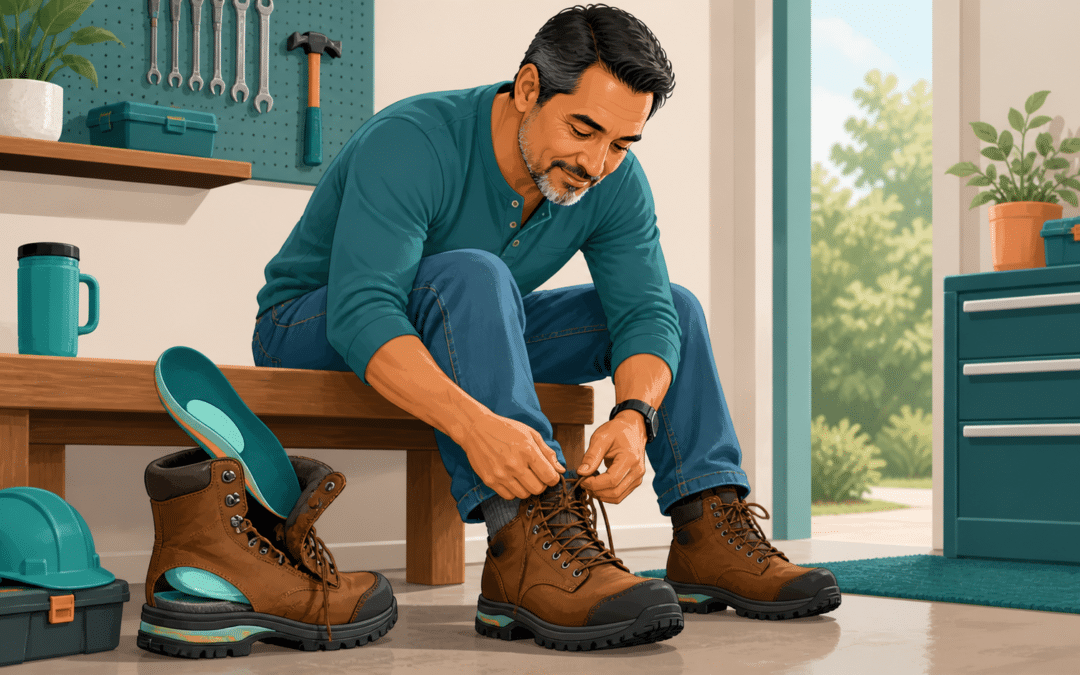
Quick Answer: What Work Boots Help Plantar Fasciitis?
The best work boots for plantar fasciitis combine job-site safety with foot-saving structure: a stable heel, supportive footbed or removable insole, shock-absorbing midsole, enough toe room, and enough depth to fit an orthotic if you need one. If the boot protects your toes but leaves your arch and heel unsupported, your plantar fascia may still be screaming by lunch.
Disclosure: This post may contain affiliate links. If you buy through them, we may earn a small commission at no extra cost to you.
Medical note: This article is educational and not medical advice. If your heel pain is severe, worsening, changing how you walk, or not improving with supportive footwear and home care, talk with a qualified healthcare professional.
Amazon Associate statement: As an Amazon Associate, I earn from qualifying purchases.
Work Boots Should Protect More Than Your Toes
If you work outdoors, in a shop, on concrete, or on a factory floor, your feet are already doing overtime before the coffee has cooled. Add plantar fasciitis and suddenly your work boots can feel less like safety gear and more like medieval punishment with laces.
The good news: you do not need magical boots forged by elves in an orthopedic volcano. You need the right features, the right fit, and sometimes the right insert. That is the winning combination.
This Guide Is for You If…
- You stand or walk on concrete, factory floors, gravel, job sites, or hard shop surfaces.
- Your heel hurts more near the end of a shift or the morning after a long workday.
- Your safety boots feel protective but flat, stiff, heavy, or unsupportive.
- You need steel toe, composite toe, soft toe, waterproof, or rugged boots and still need plantar fasciitis support.
- You are trying to figure out whether the boot is the problem, the insole is the problem, or both.
Want the big-picture footwear strategy? Start with our pillar guide: Best Footwear for Plantar Fasciitis 2026: The Ultimate Guide. And if you need insert help too, see Insoles Basics for Plantar Fasciitis.
1) Why Work Boots Hit Different When You Have Plantar Fasciitis
Regular walking shoes are one thing. Work boots are another beast entirely. They are often heavier, stiffer, and worn for longer stretches on harder surfaces. That means more repeated stress on your heel and arch if the boot does not support your foot properly.
With plantar fasciitis, the goal is not just “comfort.” The goal is to reduce repeated strain on the plantar fascia while still keeping you safe and job-site compliant. Safety comes first. The trick is finding boots that protect the foot and support it.
Mayo Clinic includes arch supports, stretching, icing, and supportive footwear as part of conservative plantar fasciitis care. Cleveland Clinic also recommends supportive shoes and avoiding barefoot walking on hard surfaces.
References: Mayo Clinic – Plantar fasciitis: diagnosis & treatment | Cleveland Clinic – Plantar fasciitis
2) The Non-Negotiables in PF-Friendly Work Boots
Here is your no-nonsense checklist. If a work boot misses most of these, your plantar fascia may start a rebellion before clock-out.
- Stable heel and strong heel counter: The rear of the boot should feel secure, not sloppy. Heel stability helps reduce extra wobble and rolling motion.
- Supportive footbed or removable insole: A removable footbed is gold because you can upgrade to a better insole if the stock one is too flat.
- Shock-absorbing midsole: Especially important on concrete. Cushion helps, but structured cushion usually beats mush.
- Roomy toe box: Safety toe does not have to mean toe-crushing. Crowded toes can change your gait and make the whole chain worse.
- Correct fit with work socks: Test boots wearing the socks you actually use on shift, not thin “trying-on” socks.
- Enough depth for inserts: A boot can be great on paper and still fail if your insert lifts your heel too high and causes rubbing.
- Appropriate outsole and traction: Slips, jolts, and awkward bracing can all make angry feet angrier.
The American Podiatric Medical Association’s Seal program also evaluates footwear, insoles, and related products for promoting foot health, which can be a useful extra clue when comparing brands and models.
Reference: APMA Seal Program – Footwear & Products
Action Box: PF-Friendly Work Boot Checklist
- [ ] Stable heel — not sloppy, wobbly, or loose
- [ ] Removable insole or supportive stock footbed
- [ ] Shock-absorbing midsole — not hard as a brick
- [ ] Toe box roomy enough with real work socks
- [ ] Fits with your insert or orthotic, if you use one
- [ ] Correct safety rating for your workplace
- [ ] Break-in plan before wearing them for a brutal full shift
3) Steel Toe vs Composite Toe vs Soft Toe
Your job requirements come first. If you need a safety toe, you need a safety toe. The plantar fasciitis move is to optimize the fit and support around that requirement, not pretend you can swap into running shoes and call it a day.
- Steel toe: Durable and common, but often heavier. Extra weight can feel more fatiguing on long shifts if the boot is stiff or poorly cushioned.
- Composite toe: Often lighter than steel and may feel less tiring for some workers, but fit still varies wildly by brand and model.
- Soft toe: Can be easier to fit comfortably, but only use soft-toe boots if they meet your workplace safety requirements.
Bob’s tip: Don’t buy by toe-cap type alone. I’d rather have a well-fitted steel-toe boot with good support than a lightweight composite boot that is flat, sloppy, and makes me limp.
4) The 2-Minute Work Boot Fit Test
Do this in the store, in your living room, or the second the package arrives — before you commit to a full shift in them.
- Heel slip test: A tiny bit can be normal in some boots, but obvious up-and-down sliding is a red flag.
- Toe room test: Your toes should not be jammed into the front, especially with safety toes.
- Heel counter pinch test: Squeeze the heel area. You generally want it supportive and structured, not collapsing like a cheap slipper.
- Twist test: The boot should not twist like a wet rag. Some flexibility is fine, but a work boot should feel stable.
- Insert depth check: If you use orthotics or insoles, put them in and make sure your heel still sits securely and your toes are not crowded.
- Walk-and-stop test: Take a few steps and stop. If your foot slides forward hard into the toe box, that boot may become shift-long misery.
5) When the Boot Is Safe but the Footbed Is Trash
This is incredibly common. A boot can have solid traction, solid protection, and still come with an insole that feels like flat cardboard with a personality problem.
If the boot fits well and meets your job requirements, you may not need to replace the whole boot. You may just need to upgrade the insert.
If you need help choosing inserts, see our Insoles Basics for Plantar Fasciitis guide.
- Start with structure: Look for real arch support and a stable heel cup, not just soft foam.
- Check volume: Some inserts are thick and can make a good boot fit badly.
- Break them in: Don’t rage-quit after one hour if you are switching from flat insoles to supportive ones.
- Re-test lacing: A better insert often changes how the boot should be laced.
Cleveland Clinic notes that orthotics include shoe inserts and that over-the-counter orthotics may be recommended for mild symptoms, while persistent or worsening symptoms may need a more advanced option.
Reference: Cleveland Clinic – Orthotics
6) Surviving Long Shifts: What Helps Besides the Boot Itself
Boots matter most, but they are not the only lever you can pull.
- Rotate boots if possible: Giving one pair a day off can help cushioning rebound and reduce moisture buildup.
- Use micro stretch breaks: A quick calf stretch against a wall, machine support, or sturdy surface can help reduce tension on the plantar fascia.
- Don’t go barefoot after work: If your heel is flaring, hard floors at home can undo some of your progress.
- Use cold therapy after shift: Ice or frozen bottle rolling can help calm things down when your heel is angry.
- Add an anti-fatigue mat where allowed: If you stand in one spot for long stretches, a mat can reduce some of the punishment from concrete.
- Replace worn-out insoles: If your support is flattened, your heel may notice before your eyes do.
If hard floors at home are part of the problem, see our Slippers for Plantar Fasciitis 2026: Cozy Support That Saves Your Heels at Home.
Reference: Harvard Health – Stretching to heal plantar fasciitis
7) Work Boot Brands to Compare
These are common work-boot lines people compare when they need safety plus comfort. Model-to-model differences matter a lot, so treat this as a shopping shortlist — not a guarantee.
- Timberland PRO – common choice with job-site focused options and shock-absorbing features in some models.
- KEEN Utility – often worth checking for toe-box comfort and wider fits.
- Carhartt Work Boots – practical option to compare, especially if you need rugged build and removable footbed potential.
- Wolverine – another common workwear brand to test for fit and insert compatibility.
- Thorogood – often compared for durability and all-day work use.
- Red Wing – premium option many workers compare for fit, durability, and support potential.
Lisa’s perspective: “The best boot on paper is still the wrong boot if it makes you limp. I’d rather see Bob in the ‘less cool’ boot that fits right than the macho boot that wrecks his feet.”
Bob’s perspective: “My dad was a cemetery superintendent for 30 years. Back then, he bought work boots at Sears and wore them out in a year. What’s available today is off the charts — but you still have to choose carefully.”
8) When It’s Time to Stop Experimenting and Get Medical Help
If you have upgraded your boots, improved support, and added basic stretching, but your pain is still severe or keeps coming back, it is time to get checked out.
- Get evaluated if: pain is severe, lasts for weeks, keeps worsening, or changes how you walk.
- Get evaluated sooner if: you have numbness, tingling, major swelling, diabetes, or symptoms that feel “not normal.”
- Bring your boots: Seriously. Your clinician seeing the actual boots and inserts can help identify fit or support issues fast.
Recommended Next Reads
- Best Footwear for Plantar Fasciitis 2026: The Ultimate Guide
- Insoles Basics for Plantar Fasciitis
- 2026 Guide: When to Replace Your Plantar Fasciitis Shoes
- Slippers for Plantar Fasciitis 2026: Cozy Support That Saves Your Heels at Home
- Effective Stretches for Heel Pain Relief: Step-by-Step
FAQ: Work Boots and Plantar Fasciitis
Q: What are the best work boots for plantar fasciitis?
A: The best work boots for plantar fasciitis have a stable heel, supportive footbed or removable insole, shock-absorbing midsole, roomy toe box, and the correct safety rating for your job. Fit matters more than brand name alone.
Q: Can steel-toe boots make plantar fasciitis worse?
A: They can if they are heavy, stiff, flat inside, or a poor fit for your foot. The fix is usually better fit plus support, often with a better insole, not automatically ditching all safety-toe boots.
Q: Are composite toe boots better for plantar fasciitis?
A: Sometimes. Composite toe boots are often lighter than steel toe boots, which may reduce fatigue for some people. But a lightweight boot with poor arch support can still aggravate plantar fasciitis.
Q: Should I choose soft boots or supportive boots?
A: Supportive wins. A boot that is only soft can still let your foot collapse and keep aggravating your plantar fascia. Aim for cushioning plus structure.
Q: Do I need custom orthotics for work boots?
A: Not always. Many people do well with a quality over-the-counter insole if the boot fits properly. If pain persists, a professional evaluation may be worth it.
Q: How long should I break in new work boots?
A: It varies by boot, but don’t debut a stiff pair on a brutal full shift if you can avoid it. Do shorter wear sessions first and test them with your actual work socks and inserts.
Q: Are work boots on concrete especially bad for plantar fasciitis?
A: They can be. Long hours on concrete usually mean more repeated impact and fatigue, especially if the boot is stiff, flat inside, or poorly cushioned. Better support, a good insert, and an anti-fatigue mat can all help.
Q: What is the biggest mistake people make when buying work boots for plantar fasciitis?
A: Buying by “comfort in the first 10 seconds” instead of checking heel stability, work-sock fit, insert compatibility, support, and safety requirements.
Wrap-Up: Protect the Job and the Heel
Work boots are supposed to protect you. If you have plantar fasciitis, that protection needs to include your heel and arch, not just your toes. The winning formula is simple: job-site safety + stable fit + real support.
Start with the boot requirements your job demands, then optimize the fit, the footbed, and the insert. That is how you stay safer and make it to clock-out without feeling like your foot is filing a formal complaint.
Next steps: review the Best Footwear for Plantar Fasciitis 2026 guide, then check Insoles Basics for Plantar Fasciitis if your boot is decent but the footbed is not pulling its weight.
Medical Disclaimer: Bob and Lisa are not doctors. We’re sharing personal experience and practical, empathy-first guidance. For medical advice, diagnosis, or treatment plans, please consult a qualified healthcare professional. We reference reputable sources including Mayo Clinic, Cleveland Clinic, Harvard Health, APMA, and FootCareMD for general education.
Keep reading
- Start here: Best Footwear for Plantar Fasciitis 2026: The Ultimate Guide
- Winter Boots for Plantar Fasciitis: Heel-Pain Friendly Support
- Hiking Boots for Plantar Fasciitis: Trail Support
- Everyday Sneakers for Plantar Fasciitis