Disclosure: This post may contain affiliate links. If you buy through them, we may earn a small commission at no extra cost to you.
As an Amazon Associate I earn from qualifying purchases.
The Bottom Line: Heat-Moldable Insoles Can Help, But They Are Not Magic
Heat-moldable insoles can be a useful middle ground between basic over-the-counter inserts and expensive custom orthotics. They may give you a closer fit than a standard drugstore insole, but they still are not the same as a podiatrist-prescribed custom orthotic. For mild-to-moderate plantar fasciitis, they may be worth considering. For severe, stubborn, or complicated heel pain, get professional guidance before turning your oven into a foot-support laboratory.
Quick Answer: Are Heat-Moldable Insoles Good for Plantar Fasciitis?
Heat-moldable insoles may help plantar fasciitis when they combine firm arch support, a stable heel cup, and enough cushioning to reduce impact. They work best when your pain is manageable, your shoes have enough room, and you follow the molding instructions carefully. They are less ideal if your pain is severe, your feet have complex medical issues, or you need a true custom device prescribed by a professional.
The first time you hear “heat-moldable insoles,” it sounds like somebody lost a bet in the kitchen.
You warm the insert, put it into your shoe, stand on it, and let it cool around your foot. Voilà: semi-custom arch support, allegedly summoned from the mysterious realm between medical science and toaster-oven wizardry.
The real question is whether heat-moldable insoles are actually useful for plantar fasciitis, or whether they’re just another product promising your heels a spa vacation while your wallet quietly packs its bags.
If you want the broader insole decision path first, start with Best Insoles for Every Budget and Lifestyle. If you are still learning the basics, see Insoles Basics for Plantar Fasciitis and Why Insoles Matter for Plantar Fasciitis.
This Guide Is for You If…
- You want something more personalized than a basic drugstore insole.
- You are not ready to pay for true custom orthotics.
- You have mild-to-moderate plantar fasciitis and want better arch fit.
- You have roomy shoes with removable factory liners.
- You are comfortable following product instructions carefully instead of “winging it,” which is how both cookies and insoles get ruined.
Medical note: Heat-moldable insoles are still over-the-counter shoe inserts, not medical diagnosis or treatment. If your heel pain is severe, persistent, worsening, or linked with diabetes, numbness, swelling, injury, or trouble walking normally, talk with a qualified healthcare professional before experimenting.
1) What Are Heat-Moldable Insoles?
Heat-moldable insoles are over-the-counter shoe inserts made from materials that soften when warmed. Once they are warm and flexible, you place them in your shoes, stand in them, and let them cool into a shape that better matches your foot.
Think of them as the “semi-custom” option. They are not the same as prescription custom orthotics, but they may fit your arches more closely than a completely standard insert pulled straight out of the package.
Most heat-moldable options are trying to do the same basic jobs as other plantar fasciitis insoles:
- Support the arch so the plantar fascia is not constantly overstretched.
- Stabilize the heel so your foot does not wobble around like a shopping cart with one bad wheel.
- Cushion impact when you walk on hard floors, sidewalks, or unforgiving work surfaces.
- Improve shoe fit when paired with footwear that has enough room.
References: Mayo Clinic: plantar fasciitis treatment, Cleveland Clinic: plantar fasciitis treatment options.
Lisa’s note: “I like the idea of semi-custom support. I do not like the idea of Bob casually baking medical-adjacent objects while pretending this is all perfectly normal.”
Action Box: Before You Buy Heat-Moldable Insoles
- [ ] Does the insole offer real arch support, not just soft foam?
- [ ] Does it have a heel cup or stable heel shape?
- [ ] Will it fit inside the shoes you actually wear?
- [ ] Are the factory liners removable?
- [ ] Are you willing to follow the molding instructions exactly?
2) How Heat-Molding Usually Works
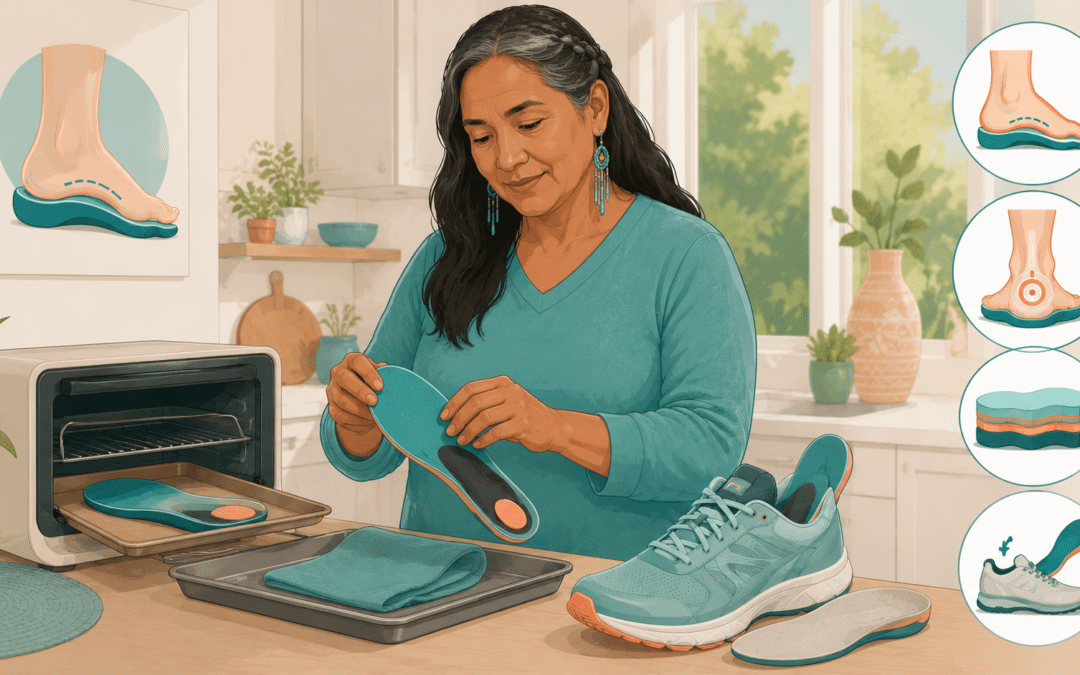
The exact instructions vary by brand, and this is one place where you do not want to improvise. Some products use a conventional oven. Some allow wear-molding, where body heat and walking gradually shape the insert. Some may recommend professional fitting.
The general idea usually looks something like this:
- Remove the factory liner from your shoe if it comes out.
- Warm the insole according to the brand’s instructions.
- Place the insole into the shoe while it is still moldable.
- Stand normally so it forms around your foot.
- Let it cool before judging the fit.
Bob’s rule: follow the product instructions, not your inner mad scientist. “A little hotter” is how you get both ruined pizza and weird foot gear.
Safety Box: Do Not Freestyle the Heating Step
- Do not overheat them.
- Do not microwave unless the brand specifically says to.
- Do not use them if they warp, smell scorched, or feel lumpy afterward.
- Do not force a thick insert into a tight shoe.
- Do not keep wearing them through sharp pain, numbness, tingling, or new pressure spots.
3) Heat-Moldable vs OTC vs Custom Orthotics
Heat-moldable insoles sit in the middle of the insole food chain. They are usually more personalized than basic OTC inserts, but less precise than prescription custom orthotics made after a professional evaluation.
| Option | Best For | Watch Out For |
|---|---|---|
| Basic OTC insoles | Budget testing, mild symptoms, easy first step. | May be too soft, flat, or generic. |
| Heat-moldable insoles | People who want a closer fit without full custom cost. | Molding errors, shoe-fit problems, not true custom. |
| Custom orthotics | Stubborn pain, unusual foot mechanics, professional evaluation. | Higher cost and possible follow-up adjustments. |
For the deeper custom-vs-OTC decision, see Custom Orthotics 101: Are They Worth the Splurge?. For budget and premium comparisons, see Dr. Scholl’s vs WalkFit and Superfeet vs PowerStep.
4) Pros of Heat-Moldable Insoles
- Better personal fit: The molding process may help the insole match your arch shape more closely than a standard insert.
- Lower cost than custom orthotics: They can be a useful middle step before paying for a professional custom device.
- Useful for roomy shoes: Sneakers, hiking shoes, and work shoes often have enough space for a more structured insert.
- Potentially re-moldable: Some brands allow a second attempt if the first fit is not quite right.
- Good for testing your support needs: They can help you learn whether firmer arch support makes your foot happier or starts a tiny rebellion.
Lisa’s perspective: “This is where I’d put them: more serious than a cheap foam insert, less serious than a podiatrist-made custom orthotic.”
5) Cons and Common Mistakes
The biggest problem with heat-moldable insoles is not the idea. It is user error, shoe mismatch, or expecting them to solve a problem they were never designed to solve.
- Overheating can ruin them: Too much heat can warp the insert or damage the materials.
- They may still be too thick: If your shoe is shallow, the insert can crowd your toes or lift your heel.
- They are not truly custom: They do not replace a professional exam, gait assessment, or prescription orthotic.
- They may not be enough for severe pain: If your plantar fasciitis is relentless, do not keep buying products instead of getting evaluated.
- Break-in still matters: Even a molded insole can feel strange at first.
If you are dealing with fit problems, pressure spots, slipping, squeaking, or toe crowding, the next post in this cluster will help: Troubleshooting Insole Woes & Common Mistakes.
6) Product Types to Consider
We are not pretending every heat-moldable or wear-moldable insole on Earth has been personally tested by Bob and Lisa. The smart move is to compare reputable options that clearly explain their molding process, arch profile, shoe compatibility, return policy, and whether they are designed for everyday shoes, athletic shoes, work shoes, or higher-volume footwear.
On Amazon, you will usually see a mix of heat-moldable and wear-moldable options from multiple brands, including names like SOLE, HappyStep, Dr. Scholl’s, Pedag, PROFOOT, PowerStep, and others. That variety is useful, but it also means you should slow down and read the details instead of grabbing the first package that says “custom fit.”
Shopping Shortcut: Compare Heat-Moldable Options
If you want to browse the broader field instead of locking onto one brand too early, start here:
7) Who Should Try Heat-Moldable Insoles?
Heat-moldable insoles make the most sense for people who are in the awkward middle zone: basic insoles are not quite enough, but custom orthotics feel like sending the cavalry before you know whether there is even a dragon.
Heat-Moldable Insoles May Be Worth Trying If…
- Your plantar fasciitis is mild-to-moderate.
- You want more arch shaping than a basic insert gives you.
- Your shoes have removable liners and enough interior volume.
- You are comfortable with a careful break-in period.
- You want to test semi-custom support before paying for custom orthotics.
Skip the DIY Route and Get Checked If…
- Your pain is severe or worsening.
- You have diabetes, neuropathy, circulation issues, or numbness.
- You cannot walk normally.
- You keep getting pressure spots or blisters from inserts.
- You have already tried several OTC options and nothing is helping.
8) Bob and Lisa’s Practical Verdict
Our take: heat-moldable insoles are not a gimmick, but they are also not a miracle. They are a tool.
If your shoes are decent, your pain is not extreme, and you want a more personalized arch feel, they can be a reasonable experiment. If your heel pain is brutal, recurring, or complicated, skip the kitchen theatrics and ask a professional what is really going on.
The best version of this strategy is simple: stable shoe, supportive insole, careful break-in, and honest tracking. If the pain improves, great. If not, you learned something without pretending a warmed-up piece of foam is a magic medical oracle.
FAQ: Heat-Moldable Insoles and Plantar Fasciitis
Q: Are heat-moldable insoles the same as custom orthotics?
A: No. Heat-moldable insoles are usually over-the-counter inserts that can shape somewhat to your foot. Custom orthotics are prescribed and made after a professional evaluation.
Q: Can heat-moldable insoles help plantar fasciitis?
A: They may help if they provide firm arch support, heel stability, and a good shoe fit. They are most realistic for mild-to-moderate cases, not severe or complicated heel pain.
Q: Can I reheat heat-moldable insoles if the first fit feels wrong?
A: Some brands allow reheating, but not all. Follow the instructions for the specific product. Do not guess.
Q: What shoes work best with heat-moldable insoles?
A: Roomy sneakers, walking shoes, work shoes, and hiking shoes usually work better than narrow dress shoes or shallow flats.
Q: Should I remove the original shoe liner first?
A: Usually, yes, if the liner is removable. Stacking an insole on top of the factory liner can make the shoe too tight and create new pressure problems.
Q: How long should I break them in?
A: Start gradually. Try short wear sessions first, then increase if your feet tolerate them. Stop if you get sharp pain, numbness, tingling, or new hotspots.
Q: When should I see a professional instead?
A: Get evaluated if your pain is severe, persistent, worsening, or connected with diabetes, numbness, swelling, injury, or trouble walking normally.
Wrap-Up: Warm Them Carefully, Judge Them Honestly
Heat-moldable insoles can be a smart middle step for plantar fasciitis relief. They offer more personalization than many basic inserts, usually cost less than custom orthotics, and may be enough for people who need better arch shape without going full podiatry custom.
But the big rule is this: do not let the DIY appeal override common sense. Follow the instructions, use the right shoes, break them in gradually, and get professional help if your pain is not improving.
Next steps: compare the broader insole options in Best Insoles for Every Budget and Lifestyle, review premium options in Superfeet vs PowerStep, or learn when custom support makes sense in Custom Orthotics 101.
Medical Disclaimer: Bob and Lisa are not doctors. We’re sharing personal experience and practical, empathy-first guidance. For medical advice, diagnosis, or treatment plans, please consult a qualified healthcare professional. We reference reputable sources for general education.
Keep reading
- Start here: Best Insoles for Every Budget and Lifestyle
- Runners’ Relief: Best Insoles for High-Impact Activities
- Fashion or Function? Balancing Arch Support with Style
- Custom Orthotics 101: Are They Worth the Splurge?