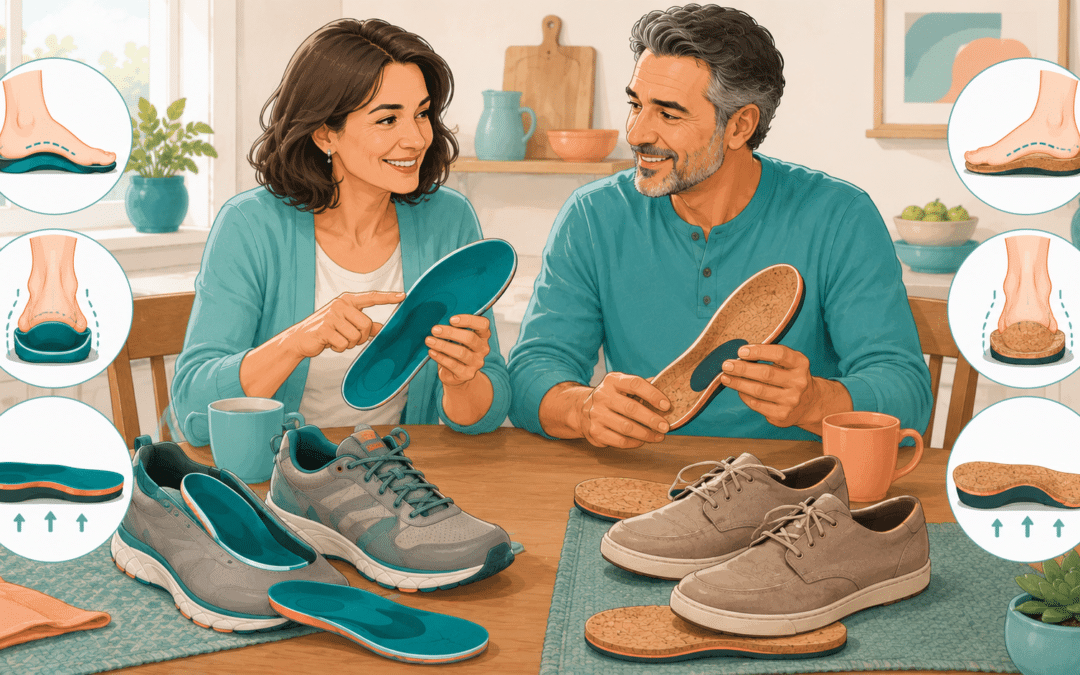
No, this is not Lisa & I. I definitely don’t look this good. See: About Us: Our Journey Through Plantar Fasciitis
Disclosure: This post may contain affiliate links. If you buy through them, we may earn a small commission at no extra cost to you.
As an Amazon Associate I earn from qualifying purchases.
The Bottom Line: Our Favorite Foot Support Took Two Different Paths
Lisa’s favorite plantar fasciitis solution has been OrthoFeet-style built-in support, while Bob’s favorite has been thick cork insoles that mold gradually to the foot. Neither answer is universal. The real lesson is that plantar fasciitis relief often comes from matching the support to the person, the shoe, and the daily routine—not blindly buying whatever the internet shouts loudest.
Quick Answer: What Are Bob and Lisa’s Favorite Insoles for Plantar Fasciitis?
Lisa leans toward OrthoFeet shoes and orthotic-style support because they solve several problems at once: cushioning, arch support, toe room, and removable insoles. Bob leans toward thick cork insoles, especially cork footbeds that gradually shape to the foot over time. Lisa’s route is more “give me the whole supportive shoe system.” Bob’s route is more “give me a sturdy insert I can drop into shoes I already like.”
Some plantar fasciitis advice sounds like it was written by a committee of shoe robots. “Select proper orthotic support for optimal biomechanical alignment.” Accurate? Maybe. Warm and helpful? About as cozy as a tax audit.
So this post is different. This is not a lab-coat ranking of every insole on Earth. This is our real-world “what actually helped us” guide. Lisa and I both dealt with plantar fasciitis, but we did not land on the exact same solution. That is the point.
If you want the broader buying guide first, start with Best Insoles for Every Budget and Lifestyle. If you want the beginner version, see Insoles Basics for Plantar Fasciitis. And if you want to understand why support matters in the first place, read Why Insoles Matter for Plantar Fasciitis.
This Guide Is for You If…
- You want personal, plain-English insole guidance instead of sterile product chatter.
- You are trying to decide between built-in orthotic shoes and removable insoles.
- You are curious about cork insoles, OrthoFeet-style support, or both.
- You have already learned that “one-size-fits-all” is not how feet work.
- You want help choosing your own direction without feeling pushed into one magic product.
Medical note: We are sharing personal experience, not medical advice. Plantar fasciitis can usually improve with conservative care, but persistent, severe, worsening, or unusual heel pain should be evaluated by a qualified healthcare professional.
1) Why Our Favorite Insoles Are Not the Same
Lisa and I are a good reminder that plantar fasciitis is not one villain wearing one cape. The pain may show up in a similar place—the heel and arch—but the reasons your foot is mad can vary.
Lisa had repeated bouts of plantar fasciitis. She needed a dependable, whole-footwear solution that could work across daily life, rehearsals, errands, travel, and all the moments when “I’ll just wear bad shoes for a little while” turns into “why am I limping through the cereal aisle?”
Bob had one major plantar fasciitis meltdown. It was memorable enough to make me take foot support seriously, but my best solution turned out to be thick cork insoles that gave me a natural, firm, mold-to-the-foot feel over time.
Note: When I got plantar fasciitis, it was my first time. Lisa had already had 2 bouts by then. And the solution that had worked best for her was Haflinger shoes. She loved them and got me a cork insert for my work shoes. When she gave them to me I said, “Are you kidding? Stick tree bark in my shoes?” A week later, I was eating humble pie. And 10 years later, I’m still buying a new pair every fall.
The only reason Lisa switched to Orthofeet is because Haflinger shoes are made of wool and don’t hold up in Minnesota winters. And also, as a performer, she needed the stylish selections Orthofeet offered.
That difference matters. Lisa needed a supportive footwear system. Bob needed a reliable removable insole. Same battlefield. Different tactics.
References: Conservative plantar fasciitis care commonly includes supportive shoes, heel inserts, arch supports, stretching, and activity adjustments according to Mayo Clinic and Cleveland Clinic:
Mayo Clinic: plantar fasciitis treatment,
Cleveland Clinic: plantar fasciitis treatment.
Action Box: Start With the Real Question
- [ ] Do I need better support inside shoes I already own?
- [ ] Or do I need shoes that are built around support from the start?
- [ ] Are my current shoes roomy enough for a real insole?
- [ ] Do I want firm, natural-feeling support or softer cushioning?
- [ ] Am I trying to solve one shoe problem or my whole daily footwear routine?
2) Lisa’s Favorite Path: OrthoFeet-Style Built-In Support
Lisa’s favorite solution has been OrthoFeet because it treats the shoe and insole as a team. That matters. A great insert inside a terrible shoe can still leave your heel muttering dark prophecies before lunch.
What Lisa liked was the all-in-one nature of the support: cushioning, roomy fit, orthotic-style footbed, softer interiors, and designs that make it easier to stop fighting the shoe itself. As much as she loved the cozy feel of Haflingers, she needed the style and all-around utility of OrthoFeet.
That does not mean OrthoFeet is automatically the answer for every person. It means that if you have plantar fasciitis plus other fit problems—wide feet, bunions, sensitive spots, pressure points, or shoes that constantly feel too tight—then an orthotic-friendly shoe line may be more useful than trying to force a powerful insole into a shoe that was never built for it.
Lisa’s take: “After my third round of plantar fasciitis, I got tired of gambling with shoes. I wanted something supportive before I even took the first step.”
Lisa’s Route May Fit You If…
- You want supportive shoes, not just supportive inserts.
- Your feet need extra room or softer interiors.
- You dislike constantly swapping insoles from shoe to shoe.
- You want footwear options across sneakers, slippers, sandals, boots, or casual shoes.
- Your current shoes fight your feet no matter what insole you try.
Browse OrthoFeet shoes and orthotic-friendly options.
3) Bob’s Favorite Path: Thick Cork Insoles
My favorite insole path has been thick cork. Cork is not squishy in the way a gel insert is squishy. It feels more firm and grounded. At first, that can feel a little strange if your foot is used to soft foam. Then, as the cork starts shaping to your foot, it can feel like the insole finally learned your name.
What I liked was the balance: firm support, natural feel, and a gradual mold-to-your-foot effect. Cork does not feel like a trampoline. It feels more like a firm, loyal floor that quietly has your back—or, in this case, your arch.
Two cork-style options often worth comparing are Haflinger cork insoles and Birkenstock Blue Footbeds. They are not identical, and you still have to match them to your shoes, but they both live in that “firm support that gradually becomes personal” neighborhood.
Bob’s note: “The first week with cork can feel like the insole is interviewing your foot. After that, if it’s the right match, it can start feeling like the two of them signed a treaty.”
Bob’s Cork Route May Fit You If…
- You like firm support more than marshmallow softness.
- You want an insole that gradually shapes to your foot.
- You have shoes with enough room for a thicker insert.
- You do not mind a short break-in period.
- You prefer replacing insoles instead of replacing a whole footwear lineup.
Take a look at the options:
Haflinger cork insoles (It appears that Haflinger no longer sells cork insoles, only replacement footbeds for their own shoes.)
and
Birkenstock Blue Footbed cork-style support.
4) Lisa’s Route vs. Bob’s Route: Which One Sounds More Like You?
Here is the plain-English comparison. No coronation ceremony. No “one true insole.” Just the practical split.
| Question | Lisa’s OrthoFeet-Style Route | Bob’s Cork Insole Route |
|---|---|---|
| Best for | People who want supportive shoes and inserts working together. | People who want a firm removable insert for shoes they already like. |
| Feel | Cushioned, roomy, supportive, forgiving. | Firm, natural, gradual mold-to-foot support. |
| Shoe fit issue | Often solves the shoe-depth and toe-room problem. | Needs shoes with enough room for a thicker insole. |
| Best personality match | “I want the whole setup handled.” | “I want the insert I like inside the shoes I choose.” |
| Watch out for | Cost if you need multiple pairs of shoes. | Break-in time and shoe-volume limits. |
5) Don’t Copy Our Feet Blindly
Here is where the internet usually gets people in trouble. Someone says, “This worked for me,” and suddenly everybody treats it like carved stone from Mount Orthotic.
Please do not do that with us either.
Our favorites are useful because they show two real paths, not because they end the debate. Your feet may need a softer insole, a lower arch, a slimmer insert, a wider shoe, a deeper heel cup, or professional evaluation.
Before buying anything, ask:
- What shoe am I trying to improve? A sneaker, slipper, boot, sandal, or dress shoe?
- How much room does that shoe have? Thick insoles need space.
- What kind of support feels better? Firm, cushioned, low-profile, high-arch, or semi-custom?
- How bad is the pain? Mild annoyance and severe persistent heel pain are not the same mission.
- Have I tried the basics? Stretching, supportive shoes, reduced barefoot time, and smart activity changes still matter.
APMA makes a helpful distinction here: retail shoe inserts can cushion and support, while prescription custom orthotics are made after a podiatrist evaluates the foot, ankle, and leg. That difference matters if your pain is stubborn or complicated. APMA: prescription custom orthotics and shoe inserts.
6) How to Test a New Favorite Without Starting a Foot Rebellion
Once you choose a direction, do not declare victory on Day 1 and march straight into a twelve-hour errand marathon. New support changes how your foot loads. That can be helpful, but your foot may need time to adjust.
Action Box: The Three-Day First Test
- Day 1: Wear the new support around the house or for a short errand.
- Day 2: Try a slightly longer walk or normal daily activity.
- Day 3: Decide whether it feels supportive, too high, too soft, too tight, or just wrong.
- Stop early: sharp pain, numbness, tingling, or limping means the setup needs to be changed.
For fit problems, read Which Insole Fits My Favorite Shoe?. If the insole still hurts after a fair test, check out “I Still Hurt!” Troubleshooting Insole Woes & Common Mistakes.
FAQ: Our Favorite Insoles for Plantar Fasciitis
Q: Are OrthoFeet shoes better than removable insoles?
A: Not automatically. OrthoFeet-style shoes may be better if your problem is the whole shoe setup: toe room, cushioning, soft interiors, removable insoles, and built-in support. Removable insoles may be better if you already own shoes that fit well and just need better arch or heel support.
Q: Are cork insoles good for plantar fasciitis?
A: Cork insoles can work well for some people who like firm support and a footbed that gradually shapes to the foot. They are not ideal for every shoe or every foot, especially if you need a very soft feel or have tight shoes with limited interior space.
Q: What is better: soft cushioning or firm support?
A: For plantar fasciitis, many people need a balance of both. Too much mushy cushioning can collapse. Too much rigid support can feel harsh. The sweet spot is usually firm arch support plus enough heel cushioning to reduce pounding.
Q: Should I buy the exact same insoles Bob and Lisa like?
A: Maybe, but do not buy blindly. Use our picks as clues. Lisa’s choice points toward built-in orthotic footwear. Bob’s choice points toward firm cork support. Your foot shape, shoe type, pain level, and comfort preference should decide.
Q: When should I skip personal recommendations and see a professional?
A: If your pain is severe, persistent, worsening, or affecting how you walk, it is time to get evaluated. Also be more cautious if you have diabetes, circulation problems, numbness, swelling, or injury concerns.
Wrap-Up: Two Favorites, One Bigger Lesson
Lisa and I landed on different favorites because our feet, shoes, and routines were different. That is the real takeaway.
Lisa’s OrthoFeet-style route makes sense when the shoe itself needs to become part of the solution. Bob’s cork-insole route makes sense when you want firm, natural-feeling support inside shoes that already have enough room.
The best insole is not the one with the loudest marketing. It is the one your feet can actually live with.
Next steps:
return to Best Insoles for Every Budget and Lifestyle,
compare Dr. Scholl’s vs WalkFit,
or review Superfeet vs PowerStep.
Medical Disclaimer: Bob and Lisa are not doctors. We’re sharing personal experience and practical, empathy-first guidance. For medical advice, diagnosis, or treatment plans, please consult a qualified healthcare professional. We reference reputable sources for general education.