

Disclosure: This post may contain affiliate links. If you buy through them, we may earn a small commission at no extra cost to you.
As an Amazon Associate I earn from qualifying purchases.
Quick Answer: Dress Shoes Don’t Have to Be Heel Sabotage
The best dress shoes for plantar fasciitis are supportive, cushioned, stable, and secure on your foot. Look for real arch support, a low-to-moderate heel, a firm heel counter, a sole that does not twist easily, and enough room for a slim insert if you need one. Thin, flat, floppy “formal shoes” may look polished, but they can keep your heel irritated all day.
Plantar fasciitis has a special hatred for dress shoes. Not because it’s picky, but because a lot of dress shoes are built like stylish boards: flat, stiff, narrow, and about as supportive as a sarcastic coworker on Monday morning.
The good news is you do not have to choose between looking sharp and keeping your heel from screaming. You just need to shop like a heel detective: support first, stability second, style third, and “cute but painful” tossed overboard like contraband on a pirate ship.
Want the big picture? Start here:
Best Footwear for Plantar Fasciitis 2026: The Ultimate Guide.
This Guide Is for You If…
- You need dress shoes for work, church, weddings, interviews, dinners, or events.
- You want formal or dressier footwear that does not punish your heel by lunchtime.
- You are trying to avoid flimsy flats, stiff loafers, narrow dress shoes, or high heels that trigger heel pain.
- You need help choosing between supportive loafers, low block heels, oxfords, dress flats, and dress sneakers.
Medical Note
Supportive shoes, stretching, cushioning, and inserts can help many people manage plantar fasciitis, but persistent or severe heel pain deserves a real medical evaluation. Bob and Lisa are sharing practical experience and research-backed guidance, not diagnosing your foot through the internet like bargain-bin wizardry.
1) Why Dress Shoes Can Trigger Plantar Fasciitis
Plantar fasciitis often improves with conservative steps like stretching, supportive shoes, cushioning, and inserts or orthotics. The flip side is also true: unsupportive, worn-out, too-flat, or poorly fitted shoes can keep the problem going.
That is why dress shoes can be trouble. Many formal shoes have thin soles, poor arch support, minimal heel cushioning, and a loose or narrow fit that makes you grip with your toes just to keep the shoe on. That is not elegance. That is your foot filing a formal complaint.
Authority references:
Mayo Clinic: supportive shoes and low-to-moderate heels,
Cleveland Clinic: flats, heels, and plantar fasciitis shoe features,
Harvard Health: support, cushioning, and worn-out shoes.
Lisa’s line, earned the hard way: “I used to think cute flats were harmless. Then I limped through a whole event. Never again.”
Action Box: The 30-Second Dress Shoe Test
- [ ] Can I feel real arch shape, not just soft padding?
- [ ] Does the heel feel stable, not wobbly, loose, or collapsible?
- [ ] Is there some cushioning under the heel?
- [ ] Does the shoe stay on without toe-gripping?
- [ ] Does the sole resist twisting like a wet noodle?
- [ ] Can I remove the insole, or at least fit a slim insert, if needed?
2) The Plantar Fasciitis-Friendly Dress Shoe Checklist
- Arch support: look for a built-in contour or a removable insole so you can add your own support.
- Heel cushioning: hard floors and thin soles are a rough combination when your heel is already cranky.
- Stability: a firm heel counter and a sole that resists twisting help your foot move more predictably.
- Secure fit: laces, straps, a closed heel, or a well-fitting loafer reduce toe-gripping and shuffling.
- Low-to-moderate heel: very high heels can shift pressure forward, while ultra-flat shoes often lack support.
- Enough depth: if you use inserts, the shoe must have room for them without jamming your toes into steerage class.
The point is simple: a dress shoe for plantar fasciitis should behave more like a supportive shoe wearing a nice jacket, not like a cardboard plank pretending to be footwear.
3) What to Avoid: The Usual Heel Villains
- Paper-thin flats: pretty, but often zero cushioning and zero support.
- Very high heels: they may look sharp, but they often change foot mechanics in ways your plantar fascia will not appreciate.
- Backless slip-ons with no structure: if you have to grip with your toes, your heel is probably paying rent.
- Worn-out soles: when the shoe is dead, your plantar fascia does the work.
- Ultra-narrow toe boxes: crowding changes how your foot moves and can make the whole system crankier.
- Hard leather soles with no cushioning: they may look formal, but they can feel brutal on concrete, tile, or long event days.
Bob’s rule: if the shoe makes you change how you walk, it is not fashion. It is sabotage with stitching.
4) Best Types of Dress Shoes for Plantar Fasciitis
| Dress shoe type | Why it can work | Watch out for |
|---|---|---|
| Oxfords and lace-ups | Secure fit, better adjustability, often more structure. | Hard soles and narrow toe boxes. |
| Supportive loafers | Can look polished while giving more coverage than flats. | Loose heel fit and weak footbeds. |
| Low block heels or wedges | Some people tolerate a low, stable heel better than a totally flat shoe. | Too much height, narrow heels, or poor cushioning. |
| Dress sneakers | Often the best compromise: cleaner look, better cushioning, more stable sole. | Some are fashion sneakers with no real support. |
For all-day work comfort that leans less formal, see
Office-Appropriate Shoes for 9-to-5 Comfort.
For everyday casual options, see
Sneaker Confidential: Everyday Shoes for Plantar Fasciitis That Don’t Betray You.
5) Dress Shoe Picks to Start Your Search
These are not magic shoes, and model quality can vary. Use the checklist above. The brand name gets you into the neighborhood; the actual shoe still has to pass inspection.
- Orthotic-friendly dress styles:
OrthoFeet dress shoes - Comfort-focused business casual styles:
Rockport dress shoes - Supportive walking-to-work hybrid styles:
Clarks dress shoes - Dress-casual support options:
Vionic dress-casual shoes
Bob & Lisa Field Rule
Do not buy dress shoes by looks alone. Buy them by mission: Where are you wearing them? How long will you be standing? Can you walk normally? Can you get through the event without planning your escape route by appetizer time?
6) What If a Dress Shoe Is Almost Good Enough?
Sometimes a shoe is close. It looks good, fits reasonably well, but still feels too flat or too dead underfoot. In that case, a slim supportive insert can make a real difference, as long as the fit still works.
- Try a low-profile insert if the shoe has limited space.
- Remove the factory liner first if the shoe allows it.
- Do not cram your foot just to force an insert into a dress shoe.
- Break the combo in gradually instead of wearing it for a ten-hour event on day one.
- Test both shoes together because one foot may tolerate the insert better than the other.
For the bigger insert strategy, see
Why Insoles Matter for Plantar Fasciitis in 2026
and
Insoles Basics for Plantar Fasciitis.
7) Dress Shoe Survival Tips for Long Days
- Break shoes in before the big day: do not debut new dress shoes at a wedding, conference, or long shift.
- Rotate shoes: do not make one pair carry your entire work life.
- Keep backup shoes nearby if you can: changing after a meeting or event can save the rest of the day.
- Stretch before and after: tight calves and feet can keep pulling on the plantar fascia.
- Retire dead shoes: if the sole is worn down or the support is gone, sentimentality will not heal your heel.
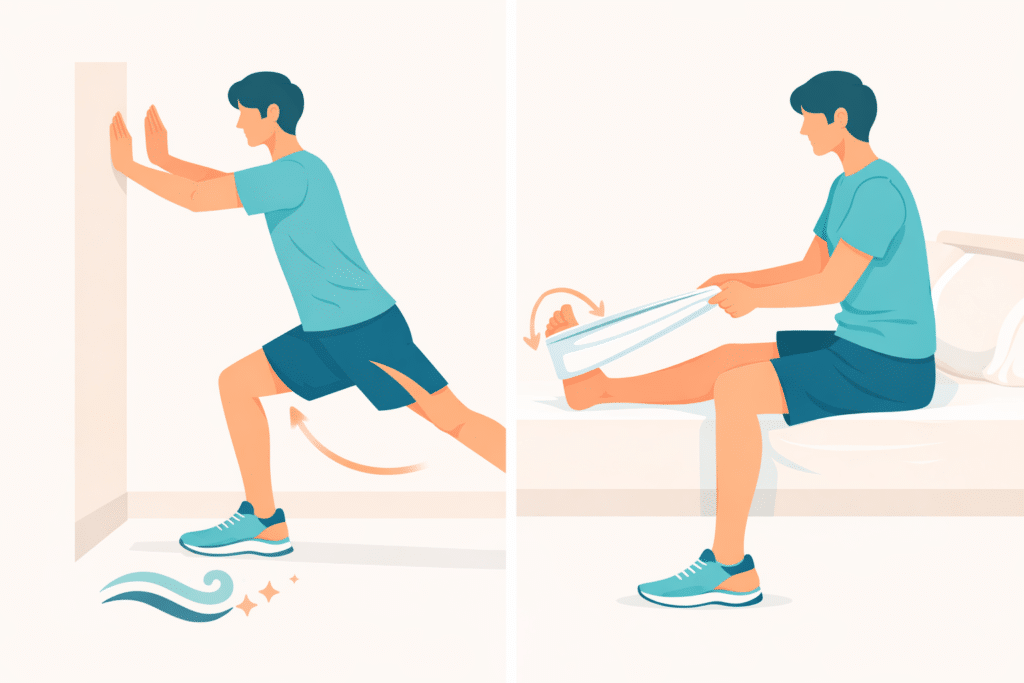
Standing wall calf stretch + seated towel stretch
For broader relief help, see
Heel Pain Relief Stretches,
Exercises for Plantar Fasciitis,
and
2026 Guide: When to Replace Your Plantar Fasciitis Shoes.
FAQ: Dress Shoes and Heel Pain
Q: What are the best dress shoes for plantar fasciitis?
A: The best dress shoes for plantar fasciitis usually have real arch support, heel cushioning, a stable sole, a secure fit, and enough room for a slim insert if you need one.
Q: Are flats bad for plantar fasciitis?
A: A lot of them are, especially the paper-thin kind with no cushioning or support. A supportive flat is one thing. A stylish pancake is another.
Q: Can I wear heels with plantar fasciitis?
A: Very high heels usually make life harder. Some people do better in low, stable block heels or wedges than in super-flat shoes, but extreme anything tends to backfire.
Q: Can I put inserts in dress shoes?
A: Yes, if the shoe has enough room. Look for removable liners or a deeper fit, and use a low-profile insert so you do not crowd your toes.
Q: Are dress sneakers cheating?
A: Not even a little. If your workplace or event allows them and your feet are happier, that is called making a smart decision.
Q: When should I see a healthcare professional?
A: If pain is severe, persistent, getting worse, or not improving with supportive changes and basic home care, get evaluated.
Wrap-Up: Look Sharp, Walk Smarter
Dress shoes for plantar fasciitis do exist, but you have to be a little ruthless. Look for support, cushioning, stability, and a secure fit. Skip flimsy shoes that only look professional from a distance while your heel quietly plots revenge.
The goal is simple: look sharp, feel steady, and get through the day without paying for it later.
Next steps:
Back to the Footwear Pillar Guide,
Office-Appropriate Shoes for 9-to-5 Comfort,
and for the broader relief plan,
Healing Plantar Fasciitis Naturally: 5 Proven Home Remedies for Fast Relief.
Medical Disclaimer: Bob and Lisa are not doctors. We’re sharing personal experience and practical, empathy-first guidance. For medical advice, diagnosis, or treatment plans, please consult a qualified healthcare professional. We reference reputable sources for general education.
Keep reading
- Start here: Best Footwear for Plantar Fasciitis 2026: The Ultimate Guide
- Office Shoes for Plantar Fasciitis: 9-to-5 Comfort
- Best Slippers for Plantar Fasciitis in 2026
- Hiking Boots for Plantar Fasciitis: Trail Support