
Disclosure: This post may contain affiliate links. If you buy through them, we may earn a small commission at no extra cost to you.
The Bottom Line: If Your Insoles Still Hurt, Don’t Assume They Failed
If your plantar fasciitis insoles are not helping, the problem may be the arch height, shoe fit, break-in period, worn-out cushioning, or the shoe itself. Before you toss the inserts into the “well, that was useless” drawer, do a quick troubleshooting check. Sometimes one small adjustment can turn a painful mismatch into useful support.
Quick Answer: Why Do My Insoles Still Hurt?
Insoles can still hurt if the arch is too high or too low, the insert makes your shoe too tight, you skipped the break-in period, the heel cup does not sit correctly, or the insole is trying to rescue a shoe that was already too flimsy. Insoles are support tools, not magic spells. They work best when the insert, shoe, foot shape, and daily routine all cooperate.
You bought the insoles. You put them in the shoes. You walked around expecting relief.
And your heel said, “Cute. Try again.”
That does not automatically mean the insoles are junk. Sometimes they are the wrong type. Sometimes they are in the wrong shoe. Sometimes your feet need a break-in period. And sometimes the shoe is so unsupportive that even a good insole is being asked to perform battlefield surgery with a butter knife.
If you are still choosing your first pair, start with Best Insoles for Every Budget and Lifestyle. For a deeper foundation on why inserts matter, see Why Insoles Matter for Plantar Fasciitis and Insoles Basics for Plantar Fasciitis.
This Guide Is for You If…
- You bought insoles and your heel still hurts.
- Your new arch support feels weird, lumpy, or too aggressive.
- Your toes feel crowded after adding an insert.
- Your heel slips, rubs, or feels unstable inside the shoe.
- You are trying to decide whether to adjust, replace, upgrade, or give up on a pair.
- You want plain-English troubleshooting before spending more money.
Medical note: Insoles can help many people manage plantar fasciitis discomfort, but heel pain has more than one possible cause. If your pain is severe, worsening, persistent, associated with numbness or swelling, or affects your ability to walk normally, check with a qualified healthcare professional.
1) Mistake: Choosing the Wrong Arch Height
Arch support is supposed to help your foot load more evenly. But the wrong arch height can feel like somebody parked a walnut under your midfoot and told you to be grateful.
A low arch insole may feel like it is not doing much. A high arch insole may feel sharp, intrusive, or pressure-heavy. The sweet spot is support that feels noticeable but not punishing.
| What You Feel | Possible Problem | Try This |
|---|---|---|
| No support, heel still pounds | Arch may be too low or too soft | Try firmer arch support or a deeper heel cup |
| Pressure under the arch | Arch may be too high or too rigid | Break in slowly or switch to a lower arch profile |
| Foot feels tilted or unstable | Insole shape may not match your foot mechanics | Try a different support style or ask a pro |
Lisa’s note: “I learned the hard way that more arch is not always better arch. If it feels like your foot is arguing with the insole every step, listen.”
Action Box: The Arch-Height Reality Check
- [ ] Does the arch support touch your foot without jabbing it?
- [ ] Does your heel sit securely in the heel cup?
- [ ] Can you stand naturally without shifting your weight away from the support?
- [ ] Does the support feel better after short wear sessions, not worse?
- [ ] Are both feet comfortable? Your left and right foot may not vote the same way.
2) Mistake: Stuffing Too Much Insole Into Too Little Shoe
This is one of the big ones. A supportive insole can be perfectly good and still fail inside the wrong shoe.
If the insert lifts your foot too high, your toes may jam into the upper, your heel may rub, or the shoe may feel tighter across the top. That is not “support.” That is your shoe turning into a tiny foot prison.
Before blaming the insole, check the shoe volume. Running shoes, walking shoes, work boots, hiking boots, and some orthopedic-style shoes usually have more room. Dress shoes, narrow flats, sleek loafers, and many fashion sneakers often have less.
For more detail on this exact problem, see Which Insole Fits My Favorite Shoe?.
3) Mistake: Leaving the Factory Liner In Place
Many shoes come with a thin removable liner. It looks like an insole, but in many cases it is more like a decorative pancake with a job title.
If you stack a new plantar fasciitis insole on top of the factory liner, the shoe may become too tight. Your arch support may sit too high. Your heel may rise out of the heel counter. Your toes may start plotting revenge.
Try this: pull out the factory liner first, then place the new insert inside the shoe. If the new insole is trim-to-fit, use the old liner as a template and trim gradually.
Bob’s tip: “Don’t cut like you’re mad at it. Trim a little, test the fit, then trim again. Foam does not grow back.”
4) Mistake: Skipping the Break-In Period
Firm support can feel strange at first, especially if your feet have been living in flat, soft, unsupportive shoes. Strange is not always bad. But sharp pain, numbness, tingling, new limping, or worsening symptoms are not signs to “tough it out.”
For structured insoles, start with shorter wear sessions. Try one or two hours at home, then build up. If you wear a firm new insole all day on Day 1 and your feet rebel, that may be a break-in problem rather than a product failure.
Simple Break-In Plan
- Day 1: 1–2 hours around the house.
- Day 2–3: 2–4 hours if there is no sharp pain.
- Day 4–7: gradually increase normal wear time.
- Stop and reassess: if pain gets sharper, numbness appears, or your gait changes.
5) Mistake: Expecting Insoles to Do the Whole Job
Insoles are useful. Insoles are not superheroes with capes and tiny little arch-support utility belts.
Plantar fasciitis usually responds best to a combination approach: supportive shoes, inserts or orthotics when appropriate, stretching, activity adjustments, and not spending half the day barefoot on hard floors.
Mayo Clinic includes stretching, supportive shoes, heel inserts, and arch supports among common plantar fasciitis treatment steps. Cleveland Clinic also lists supportive shoes, orthotics or shoe inserts, rest, icing, and stretching as common nonsurgical options.
References: Mayo Clinic Orthopedics & Sports Medicine: plantar fasciitis treatment, Cleveland Clinic: plantar fasciitis.
For stretching help, see Effective Stretches for Heel Pain Relief and Exercises to Relieve Plantar Fasciitis.
6) Mistake: Ignoring Worn-Out Insoles
Sometimes the insole did work. It just died quietly while you were busy living your life.
Foam compresses. Heel cups lose shape. Top covers wear down. Support that once felt helpful may slowly flatten into something that has all the structural ambition of cold oatmeal.
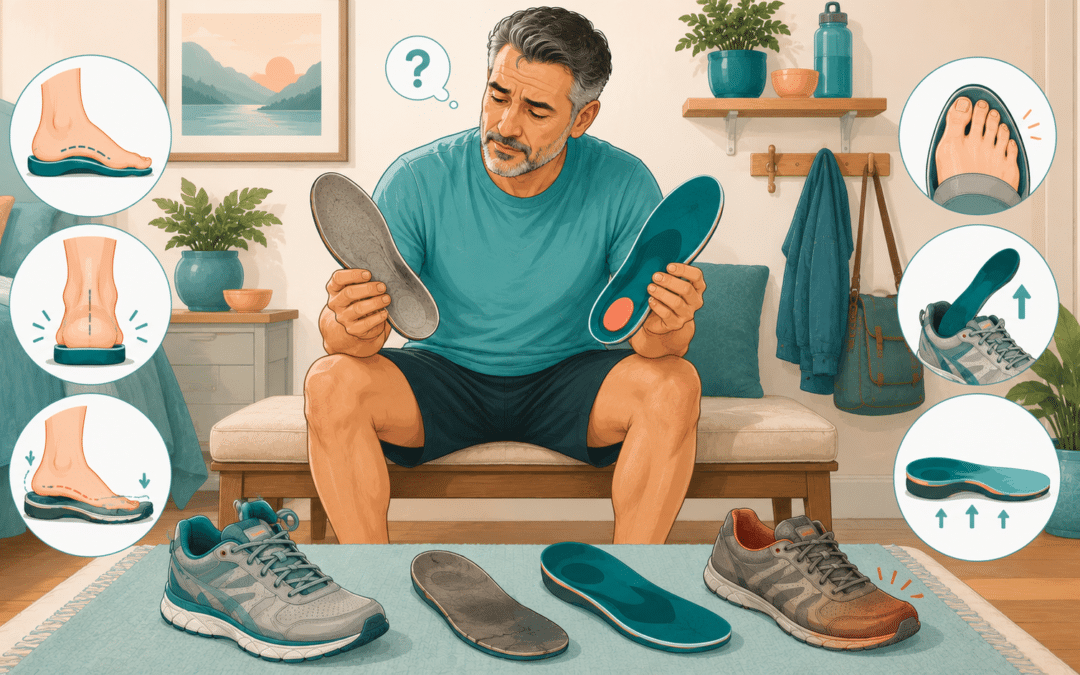
If your heel pain returns after months of doing well, check the insert before assuming your whole routine failed. Compare the old insole with a newer pair if you can. Look for compressed foam, curled edges, cracked plastic, odor that will not quit, or an arch that has lost its shape.
For a fuller replacement guide, see Insole Maintenance & Replacement: Making Them Last.
7) Mistake: Trying to Save the Wrong Shoe
This is the one nobody likes, because favorite shoes have emotional leverage. But sometimes the shoe is the villain.
If a shoe twists easily, collapses through the midfoot, has a narrow toe box, or has no room for an insert, a good insole may not be enough. You may need a more supportive shoe with removable liners and enough depth to accept orthotics.
This is where orthotic-friendly footwear can matter. Brands such as OrthoFeet are often worth considering when the problem is not just the insert, but the shoe’s depth, toe room, cushioning, and removable insole setup.
If you want to compare shoe categories, start with Best Footwear for Plantar Fasciitis 2026: The Ultimate Guide. For specific shoe types, see Everyday Shoes for Plantar Fasciitis, Dress Shoes for Plantar Fasciitis, and Work Boots for Plantar Fasciitis.
8) Mistake: Not Knowing When to Upgrade
Budget insoles can be a smart starting point. But if the foam collapses quickly, the arch never feels supportive, or your pain keeps returning, it may be time to compare stronger options.
That does not automatically mean you need custom orthotics. It may mean trying a more structured premium insole, a heat-moldable option, or a shoe built to accept orthotics properly.
- For budget comparisons, see Dr. Scholl’s vs WalkFit.
- For stronger OTC support, see Superfeet vs PowerStep.
- For semi-custom options, see Heat-Moldable Insoles.
- For professional custom support, see Custom Orthotics 101.
Action Box: The 5-Minute Insole Troubleshooting Test
- [ ] Remove the factory liner and test the insole again.
- [ ] Check whether your toes feel crowded or your heel slips.
- [ ] Wear the insole for a short break-in session, not a marathon errand run.
- [ ] Compare the arch height to your actual foot comfort.
- [ ] Look for signs the insole is worn out.
- [ ] Ask whether the shoe itself is too flimsy or too shallow.
- [ ] If pain is worsening, stop experimenting and get professional help.
FAQ: Insole Troubleshooting and Common Mistakes
Q: Why do my plantar fasciitis insoles hurt my arches?
A: The arch may be too high, too firm, or simply the wrong shape for your foot. Try a shorter break-in period first. If the pressure feels sharp or keeps getting worse, switch support styles or ask a healthcare professional.
Q: Should I remove the factory insole before adding a plantar fasciitis insert?
A: Usually, yes. If the factory liner is removable, take it out before adding the new insert. Stacking insoles can make the shoe too tight and throw off the fit.
Q: How long should I break in new insoles?
A: Start with one or two hours, then build up over several days if they feel okay. Do not start with a long walk, work shift, or run in brand-new firm insoles.
Q: Can a good insole fix a bad shoe?
A: Sometimes it can improve a borderline shoe, but it cannot fully rescue a flimsy, twisted, shallow, or badly fitting shoe. The shoe still has to provide a stable platform.
Q: Why did my insoles help at first, then stop helping?
A: They may be worn out. Foam compresses, heel cups lose shape, and arch support can weaken over time. Check for flattening, curling, cracks, odor, or returning heel pain.
Q: When should I stop troubleshooting and see a professional?
A: If your pain is severe, worsening, persistent, or comes with numbness, swelling, or difficulty walking, it is time to get evaluated.
Wrap-Up: Tweak, Test, Then Decide
If your insoles are not helping yet, do not panic and do not immediately blame your feet. Check the arch height. Check the shoe fit. Remove the factory liner. Break them in slowly. Look for signs of wear. And be honest about whether the shoe itself is part of the problem.
The goal is not to buy endless inserts like you are collecting foot-shaped trading cards. The goal is to find the combination of support, cushioning, shoe depth, and daily habits that calms your heel down.
Next steps: return to Best Insoles for Every Budget and Lifestyle, compare Superfeet vs PowerStep, or review Which Insole Fits My Favorite Shoe?.
Medical Disclaimer: Bob and Lisa are not doctors. We’re sharing personal experience and practical, empathy-first guidance. For medical advice, diagnosis, or treatment plans, please consult a qualified healthcare professional. We reference reputable sources for general education.
Keep reading
- Start here: Best Insoles for Every Budget and Lifestyle
- Insole Maintenance & Replacement: Making Them Last
- Why Insoles Matter for Plantar Fasciitis Relief
- Which Insole Fits My Favorite Shoe? Master Mix & Match!